




Advertisement
Advertisement
Encountering dogs, cats, and other animals is a typical part of campus life for students at Eckerd College, a liberal arts institution in Florida where pets are permitted to reside in dormitories.
Sophie Nocera, a senior at Eckerd, mentioned that she is likely more familiar with the names of pets than those of her fellow students.
“That’s true for many students here,” said Nocera, who shares her campus life in St. Petersburg with her Border collie, Zuko. “When I’m out walking my dog, I often hear, ‘Oh my god, hi, Zuko!’ It’s almost like I’m invisible.”

Sophie Nocera, 21, a senior at Eckerd College, plays with her dog Zuco on Wednesday, Aug. 20, 2025 in St. Petersburg, Fla. (AP Photo/Tina Russell)
Sophie Nocera, 21, a senior at Eckerd College, plays with her dog Zuco on Wednesday, Aug. 20, 2025 in St. Petersburg, Fla. (AP Photo/Tina Russell)
Some universities across the nation, such as the Massachusetts Institute of Technology and Stephens College in Missouri, also permit pets in campus residences.
For students, having pets can alleviate stress, anxiety, and homesickness. Institutions also find that pets enhance student engagement and foster connections among peers.
Federal law mandates that public and private colleges accommodate service and emotional support animals in student housing. However, an increasing number of schools are allowing pets with specific restrictions.
Not all animals are welcome on pet-friendly campuses
MIT permits only cats, and only in certain preapproved areas. At Eckerd, students can bring family pets to campus after their first semester, provided the pets have been part of their home life for at least six months and are neither venomous nor aggressive.
At the University of Northern Colorado, students in three out of more than a dozen residence halls are allowed to have dogs and cats. The animals must be at least 6 months old and weigh no more than 40 pounds (18 kilograms). Each student is allowed only one pet. This fall, the university anticipates the highest number of registered pets on campus since it began allowing them over a decade ago, according to Jediah Cummins, executive director of housing.
“One of the markers of adulthood is, ‘Can I not just take care of myself, but can I take care of another living being?’ That’s an important part of this,” Cummins said.
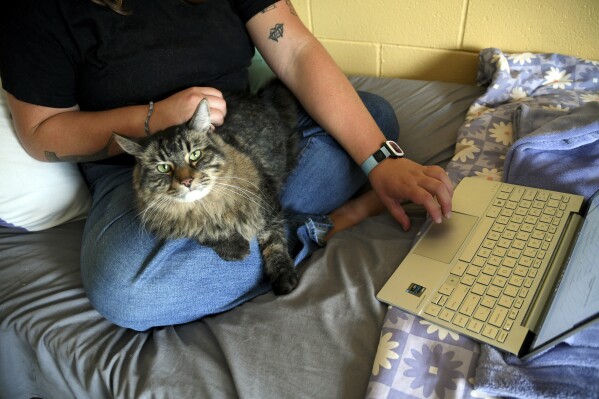
Student Molly Cheer sits with her pet comfort cat, Louie, as she looks at upcoming course work in her dorm room at the University of Northern Colorado in Greeley, Colo., on Monday, Aug. 25, 2025. (AP Photo/Thomas Peipert)
Advertisement
Advertisement


Advertisement


